
A few practices that might help mitigate sorrow and despair
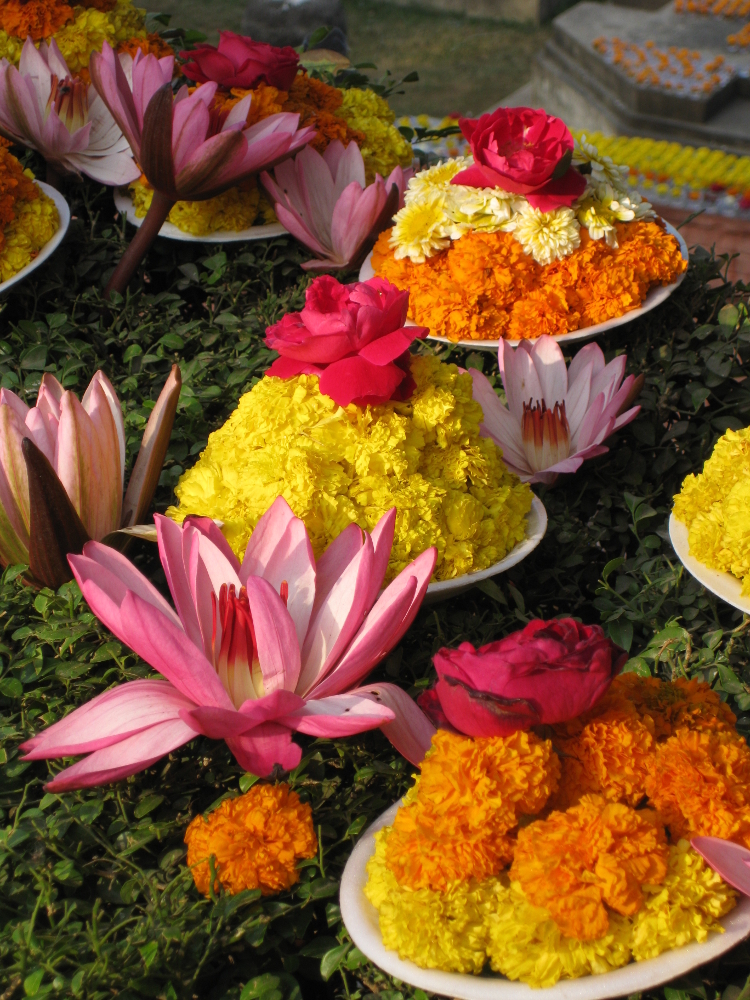
flower offerings at Mahabodhi temple, Bodhgaya, IndiaMettā / kindness and rest
A short talk exploring mettā: how it’s supported by our capacity to rest, and is itself a restful quality
In the language of the suttas, the Buddha’s discourses, many of the words that are used in conjunction with mettā and other skilful qualities, are words like abiding, dwelling, pervading, saturating … So there’s a sense that we do want to stay in these beautiful heart spaces: stay, and rest there, so that over time, they become more and more our true home.
It works the other way, too. It’s much easier to access mettā from a state of rest, than from busyness. Perhaps that can give us permission to let ourselves rest more fully, in those moments when we aren’t quite so busy, and linger, dwell in kindness.
This is a whole practice in itself, to find the gaps between tasks, and consciously stop for a minute or two, instead of jumping right to the next thing, and the next, the next, the next.
Developing that habit of pausing between activities gives some micro-relief from the agitation of busyness, and over time it gets easier to slow or stop the build-up of stress and agitation. And that in itself, is another form of kindness to ourselves.
You can listen to the full 16 minute talk on Dharmaseed hereJoan Halifax Roshi
Practicing GRACE to avoid empathy burnout
My heart went out to Dolma (a young burn victim having her infected wounds cleaned), who cried throughout the procedure, her tears reflected in her father’s anguished eyes. As I stood there, my heart rate increased and then dropped precipitously, my skin grew cold and clammy, my skin grew cold and clammy, and my breath was shallow and rapid. I was pretty sure I was going to faint, and I thought about leaving the room, but I also felt it was my responsibility to hold the space for the men and women who were performing this difficult procedure. Within another few seconds, my own internal space had closed down into a small tight fist of distress, and passing out became an even more imminent possibility. Dolma seemed to have slipped into my skin, and I was overwhelmed with my perception of her pain.
In some way, this experience of distress was also a wake-up call. I saw I was on a dangerous edge—one not unfamiliar to me. I realized that getting through this was not a matter of avoiding what I was witnessing; it was not a matter of shutting down, or walking out of the room, or letting go into a dead faint. I recognized that my identification with the child’s experience had spiraled out of control, and if I were to stay in the room, I needed to shift from hyper-attunement to care, from empathy to compassion.
I was experiencing empathic distress, a form of vicarious suffering that comes with feeling the pain and suffering of another. When I realized this, I used an early version of GRACE, an approach I created for moving out of such distress and into compassion. … in brief, GRACE is a mnemonic for:
GATHERING OUR ATTENTION
RECALLING OUR INTENTION
ATTUNING TO SELF AND THEN OTHER
CONSIDERING WHAT WILL SERVE
ENGAGING AND THEN ENDING THE INTERACTION
from Standing at the Edge by Joan Halifax Roshi
“Bright Spot” walk
from my July 2022 newsletter
Play with walking around your neighbourhood – or wherever you happen to be – letting your attention be drawn to whatever is pleasant.
Notice all five physical senses: pleasant sights, sounds, smells, tastes, physical sensations; and mental activity, too.
See if you can stay with the immediacy of the pleasant experience, not trying to hold on to it and not pushing it away. Just allow your awareness to rest in the simple knowing of these “bright spots” in the flow of experience.
At times you might notice some pleasant emotions coming up in response to these bright spots. Let yourself open to these, naming or just knowing, for example, appreciation, gratitude, openness, warmth, delight, ease, happiness, wonder, awe …
The Book of Delights (2019)
A variation of gratitude practice, from US poet Ross Gay
One day last July, feeling delighted and compelled to both wonder about and share that delight, I decided that it might feel nice, even useful, to write a daily essay about something delightful. I remember laughing to myself for how obvious it was. I could call it something like The Book of Delights. I came up with a handful of rules: write a delight every day for a year ; begin and end on my birthday, August 1 ; draft them quickly ; and write them by hand. The rules made it a discipline for me. A practice. Spend time thinking and writing about delight every day.
It didn’t take me long to learn that the discipline or practice of writing these essays occasioned a kind of delight radar. Or maybe it was more like the development of a delight muscle. Something that implies that the more you study delight, the more delight there is to study. A month or two into this project delights were calling to me: Write about me! Write about me! Because it is rude not to acknowledge your delights, I’d tell them that though they might not become essayettes, they were still important, and I was grateful to them. Which is to say, I felt my life to be more full of delight. Not without sorrow or fear or pain or loss. But more full of delight. I also learned this year that my delight grows — much like love and joy — when I share it.
What else?
What practices or strategies to you use to help find some consolation during times of overwhelm? If you have any to share, please contact me via the form on the About page of this website.
 Jill Shepherd: insight meditation
Your 20 minute beginner meditation was so beautiful and I am so very thankful that I was able to listen to it. I sat for 20 minutes and the time has never gone so fast and I was moved to the most beautiful tears I’ve ever had! I can’t say enough how much I appreciate you. I will donate soon because I want to so much. Thank you thank you thank you!!!
Thanks Julius, I’m happy you found the meditation helpful.