A few perspectives on confronting the reality of the climate crisis.
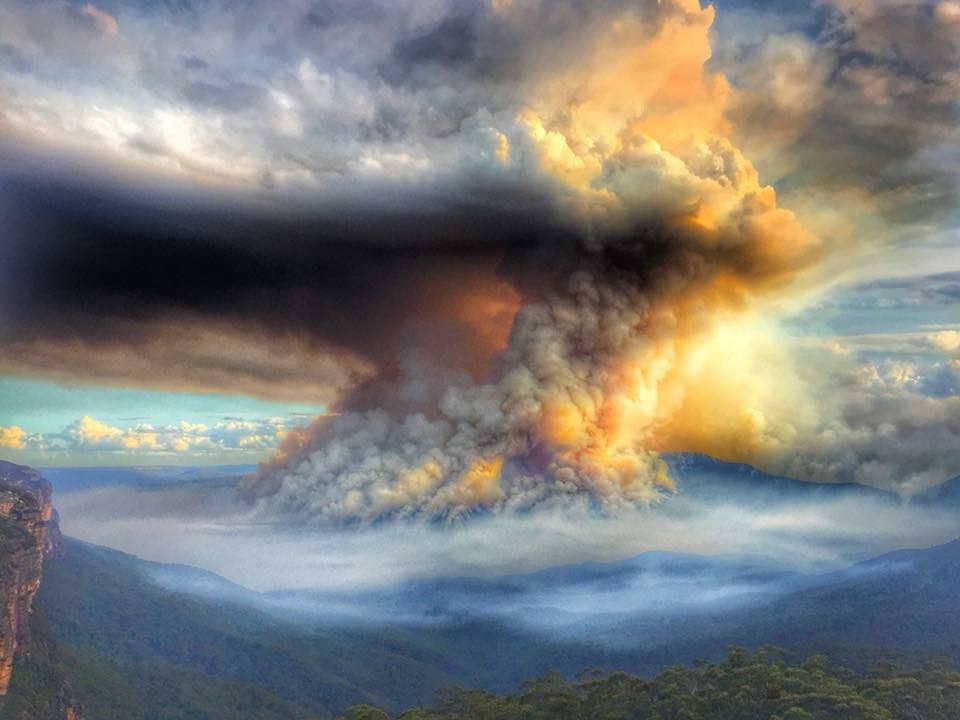
Blue Mountains backburn - photograph by John OrmeUS dharma teacher James Baraz
As a Dharma teacher who is very concerned about climate, I have been aware for some time that practitioners are often resistant to hearing Dharma talks on this subject. I have been told at times that the topic is “too political” and “off point”—they have come to hear the teachings to be comforted in order to address their own personal suffering and hardly want to be asked to take on even more. They understandably seek to escape from the intensity and bombardment of sensational news filled with acrimony, divisiveness, and fear that one must work hard to avoid. But I wonder about the contradiction of engaging in practice while avoiding the truth.
While wanting to offer words that can calm the mind and heart, I also take to heart the Buddha’s example that in order to truly be free we need to directly acknowledge dukkha so we can skillfully transform it into compassion and wisdom. I wrestle with finding the balance between words that can soothe and support in facing the climate crisis and those that challenge us to wake up to the fact that we are like children playing with our toys without realizing that the house is on fire.
from the foreword to Bhikkhu Anālayo’s book Mindfully Facing Climate Change
Bhikkhu Anālayo's book is available as a free pdf download hereAjahn Sucitto
My sense is that this status quo is in itself innately unstable – that nature, both planetary and human, cannot support a domination paradigm indefinitely, because the bottom line is that it depends on living systems whose resources are finite. The soil becomes barren or is washed away, the water and air become toxic, and climate change wreaks havoc. Also, at a certain level of stress, people just can’t continue with the kind of energies and attitudes that it takes to push harder, to produce more and at the same time contribute to the degradation of their living space. Although this breakdown has a sense of inevitability to it, action is necessary to resist its effects and build up healthier alternatives. This is basic Buddhist practice: resist greed, hatred and delusion, develop restraint, goodwill and wisdom. As action is an important aspect of our humanity, to steadily desist from participating in activities that abuse life is already a powerful undertaking. I think it is our duty. Wherever possible, alternatives should be sought and developed to turn the tide.
Revolutions, quiet as well as violent, are part of our history, and I would hope that through participating in an outspoken one, albeit conducted with compassion, patience and resolve, we can restore what remains of our environment. The search for new ways of existing in the world is also a part of our ongoing history; with enough understanding of our blind spots and with the right kind of guidance, we may yet forge a more agreeable future. I feel that the Buddha’s teaching (Dhamma) can offer at least some of this guidance, since the Buddha addressed human nature – the magic and the muck of it – in deep and timeless ways.
from the book Human Nature, Buddha Nature
Ajahn Sucitto's book is available as a free pdf hereLiving in the time of dying
A documentary by Australian film-maker Michael Shaw
it includes interviews with dharma teacher Catherine Ingram plus strategist & educator on social change Jem Bendell, award-winning journalist Dahr Jamail and indigenous Elder, author and enrolled citizen of The Chiricahua Apache Nation, Stan Rushworth.
“I began interviewing some key people who were publicly talking about the issue directly and honestly. Starting with Catherine Ingram, dharma teacher and author of online extended essay, “Facing Extinction“. She was the first person to open my eyes to the truth of the situation and my understanding was steeped in many long hours of conversation between us.”
Catherine Ingram
Facing Extinction
As time marched on, I began to awaken to how fast the climate was changing and how negative would be its impacts. It became a strange relief to read and listen to the truth of the situation from people who were studying the hard data as it affirmed my instincts and threw a light on what had been shadowy forebodings, dancing like ghosts in my awareness. It is an ongoing study that has taken me through a powerful internal process–emotional and cathartic–one that I felt might be helpful to share with those who have woken to this dark knowledge or are in the process of waking to it, just as I, over time, found comfort in the reflections of the small yet increasing number of comrades with whom I share this journey.
Because the subject is so tragic and because it can scare or anger people, this is not an essay I ever wanted to write; it is one I would have wanted to read along the way. But the words on these pages are meant only for those who are ready for them. I offer no hope or solutions for our continuation, only companionship and empathy to you, the reader, who either knows or suspects that there is no hope or solution to be found. What we now need to find is courage.
The whole essay by Catherine Ingram can be found hereOur Real Home: A Talk to an Aging Lay Disciple Approaching Death
by Ajahn Chah
Even if your house is flooded or burnt to the ground, whatever the danger that threatens it, let it concern only the house. If there’s a flood, don’t let it flood your mind. If there’s a fire, don’t let it burn your heart. Let it be merely the house, that which is external to you, that is flooded and burnt. Allow the mind to let go of its attachments. The time is ripe.
Upstream Podcast: The Myth of Freedom Under Capitalism
NOTE: this is not a dharma resource as such, but it offers some thought-provoking perspectives on what we mean by freedom
Although its intellectual handmaidens love to insist otherwise — capitalism is not a system that truly embodies freedom. We all feel it, of course — that nagging sense that we lack any agency over the choices that shape our lives, the frustration we feel at our bosses, the tension we feel with our landlords, the sense that we’re all just stuck in a rat race. We might lack the language to articulate it, or a framework within which to situate it, but we all know, deep down, that this ain’t it. That there’s something deeply wrong.
In this episode, we explore why this is — why, despite what we’re constantly being told — that we currently live under the freest system ever — that we’re not actually free — and why we’re all imprisoned within capitalism.
We start with a brief history of how we got here, what different conceptions of freedom have meant historically — and how they can be applied to our current condition, and then we take a deep dive into the mechanisms this system uses to keep us all imprisoned, and how we can break free.
 Jill Shepherd: insight meditation